
What Is the 'scent of Man'? How Biology, Culture & Fragrance Interact
What Is the 'Scent of Man'? How Biology, Culture & Fragrance Interact
The scent of a man emerges from the convergence of biology, skin chemistry, cultural conditioning, and fragrance. None of these forces acts alone.
If you arrived here searching for the film, television series, or song, this is a different direction entirely. The focus here is olfactory: what men naturally smell like, what makes those smells attractive, and how composed fragrance interacts with all of it.
The straightforward answer: natural human scent is shaped by genetics, microbiome, diet, and hormone activity. Applied fragrance layers over that foundation, and the result is unique to each person. There is no universal "masculine" scent, biologically or culturally. What reads as distinctly male in one tradition appears neutral or even feminine in another, and what counts as attractive varies significantly between individuals.
Understanding both the biology and the craft gives you something more useful than a list of top fragrances. It gives you a framework for finding a fragrance that genuinely suits you and for understanding the broader culture of scent that sits beneath every bottle on a shelf.
What Do Men Naturally Smell Like? The Biology of Body Odor
The natural scent of a man comes primarily from the interaction between skin secretions and the microbiome, the community of bacteria living on the skin's surface. Sweat itself is largely odorless. The characteristic smell associated with the human body develops when bacteria metabolize compounds secreted by the apocrine glands, which are concentrated in the underarms, groin, and chest.
Two types of sweat glands matter. Eccrine glands, distributed across most of the body, produce sweat that regulates temperature. Apocrine glands, active from puberty onward, produce a thicker secretion rich in proteins and lipids. Bacteria break those compounds down into molecules including androstenone and androstenol, which researchers classify as androstenes, steroids present in human secretions that vary in concentration by sex. Adult men generally produce higher concentrations of these compounds than women do, which contributes to the perceptual difference in body odor between sexes.
Genetics plays a substantial role. The major histocompatibility complex (MHC), a set of genes central to immune function, also influences body odor. Each person's MHC configuration contributes a distinct olfactory signature, one that is stable and largely outside your control.
Diet, stress, and hormonal cycles further modulate what comes through the skin. Garlic, red meat, and alcohol all alter the body's chemical output. Chronic stress changes the composition of apocrine secretions.
The common mistake is treating natural odor as something to be entirely suppressed. Antiperspirants reduce sweating, which reduces the substrate bacteria work on, but they cannot neutralize the underlying olfactory signature. A fragrance applied over a clean, healthy body interacts with that signature. It does not replace it. Understanding this shifts how you think about choosing a fragrance, because the question becomes not "what does this smell like in the bottle?" but rather "what will this smell like on me, specifically?"
What Is the Most Attractive Smell on a Man? What Research Suggests
The most attractive smell on a man is not a specific fragrance note but a combination of genetic compatibility, personal context, and the way a well-chosen fragrance harmonizes with natural scent rather than obscuring it. Research points consistently in one direction: genetic dissimilarity in MHC tends to produce mutual attraction.
The MHC research represents one of the most widely cited areas in olfactory science. The core finding, replicated across multiple independent studies, is that people tend to find the natural odors of genetically dissimilar partners more attractive than those of similar ones. The evolutionary logic is straightforward: offspring of genetically diverse parents carry a broader immune repertoire. These studies do not tell you which cologne to buy. They do confirm that no single scent is universally attractive, because attraction is partly a response to whether someone's immune genetics complement your own.
Commercial pheromone products deserve direct skepticism here. The claim that a bottled pheromone spray will increase attraction is not supported by the scientific literature. Human pheromone communication, while it likely exists in some form, does not operate as a simple on-off switch triggered by a topical product. The compounds involved are subtle, context-dependent, and difficult to isolate in a way that transfers to a commercial application.
What makes a fragrance attractive, then? Fragrance communities report that well-constructed compositions, ones using quality materials and allowing skin chemistry to develop the dry-down, are consistently preferred over aggressive, uniform projectors. A fragrance that smells different on one person than another is not a flaw; it is the mechanism working correctly.
Some cultures have long understood this. Traditions in which natural body scent and applied fragrance are intentionally combined treat the body as a canvas rather than a surface to be neutralized, layering oud-based oils and resins so they fuse with personal scent over hours.
The practical takeaway: testing fragrance on your skin, not on a blotter, and allowing a full dry-down of thirty minutes to an hour before deciding is not a ritual but a necessity.
How Culture Shapes What We Call a 'Masculine' Scent
What we perceive as a masculine scent is largely a cultural construction, and one that has shifted substantially over the past two centuries. The association of men with dry, woody, or leather-forward fragrance is modern, not timeless.
In the 18th century, European men routinely wore powdery florals and heavily floral waters, scents now marketed exclusively to women. The gendering of fragrance as we recognize it today accelerated through the 20th century, driven by mass-market advertising that found it more efficient to create distinct product categories than to trust consumers with complexity. "For men" on a bottle is a marketing convention, not a biological or olfactory truth.
The notes most commonly coded as masculine in Western markets have interesting historical origins. Fougère structures built on lavender, oakmoss, and coumarin, citrus colognes, tobacco and leather accords, all arrived at their current associations through commercial decisions rather than inherent properties. Fougère Royale, often cited as the origin of the modern men's fragrance family, was created in 1882. The conventions it established calcified into category rules that persisted for most of the 20th century.
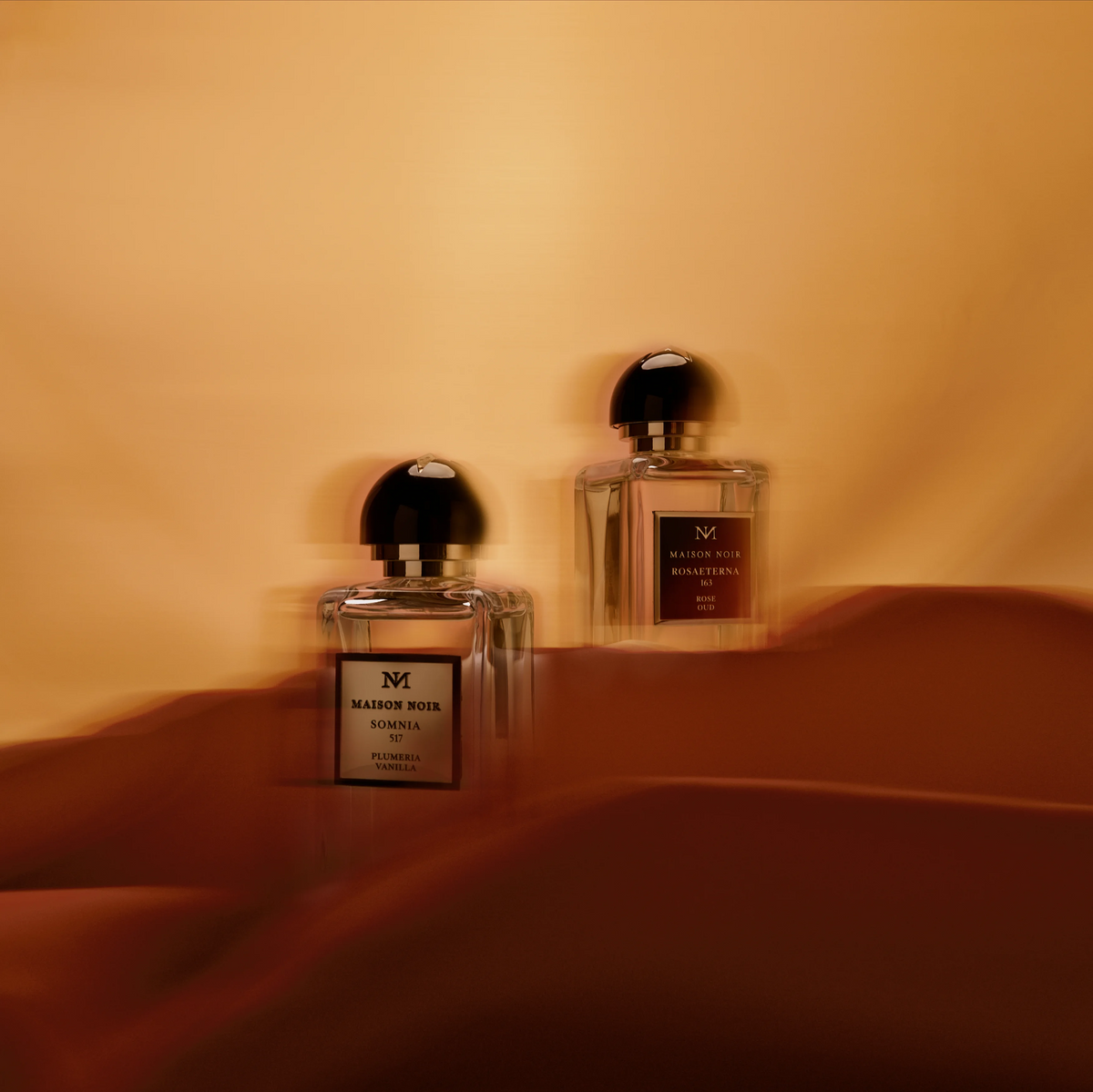
That calcification is now loosening. Fine fragrance is moving in a more interesting direction, one that niche fragrance houses think about differently, and unisex composition is becoming the working assumption for many serious perfumers. Maison Noir was built on this premise from the beginning. Every fragrance in the line is unisex, numbered rather than gendered, and composed to interact with the wearer's skin rather than announce a gender category.
The practical consequence for you: ignore the marketing gender on any bottle. Choose by note structure, by how a fragrance develops on your skin, and by the occasion you want it to serve. "This smells masculine" is not a useful criterion. "This smells like the version of myself I want to project on a given day" is.
Fragrance Families and How They Interact with Skin: A Practical Guide
The family a fragrance belongs to determines how its materials will behave on your skin, and understanding that relationship helps you predict performance before you commit to a full bottle. Different molecule classes respond differently to skin warmth, pH, and hydration levels.
| Family | Dominant Notes | How Skin Chemistry Affects It | Typical Wear Context |
|---|---|---|---|
| Fougère | Lavender, oakmoss, coumarin | Skin warmth amplifies the herbal, hay-like quality; drier skin can flatten the oakmoss | Formal or professional settings, cooler months |
| Woody/Oud | Sandalwood, cedar, oud, vetiver | Rich in fixatives; skin oils deepen and extend the resinous base | Evening, autumn and winter, occasions requiring presence |
| Citrus/Aromatic | Bergamot, neroli, citrus rind, herbs | Top notes evaporate quickly; warmer and oilier skin loses citrus faster | Warm weather, daytime, active wear |
| Oriental/Gourmand | Vanilla, amber, benzoin, tonka | Warm skin amplifies sweetness; can become overpowering if over-applied | Evening, cooler weather, intimate settings |
| Fresh/Aquatic | Marine accords, green notes, light musks | Performs best in moderate conditions; fades faster on very dry skin | Daytime, warmer months, casual contexts |
| Floral | Rose, jasmine, iris, plumeria | Skin acidity can intensify or muffle florals; patch testing is especially important | Varied; depends on supporting base notes |
The skin-chemistry mechanism is relatively straightforward. Fragrance molecules are volatile, and they evaporate at rates determined by molecular weight and their interaction with your skin's surface. Warm, well-hydrated, or slightly oily skin tends to slow evaporation of middle and base notes, extending the dry-down and deepening the projection. Dry skin, by contrast, absorbs fragrance quickly and may require more product or more frequent reapplication.
Fragrance collectors report that the same bottle smells meaningfully different on two people in the same room, and that summer skin versus winter skin on the same person produces distinct results. Exploring the floral and gourmand fragrance family in depth is useful if you find yourself drawn to sweeter or more floral structures. If woody and resinous profiles interest you, a comparison of oud against more familiar cologne structures covers that ground in detail. For those who prefer to experience families through samples before buying, the practice of scent swapping within fragrance communities is worth understanding.
How to Wear Fragrance Intentionally: Application, Concentration, and Longevity
Wearing fragrance well means applying it to the right places, at the right concentration, and with an understanding of how it will evolve over time. The goal is not maximum projection but a coherent scent that works with your natural odor rather than overwhelming it.
Apply to pulse points. The inner wrists, neck, and the inside of the elbows are warm areas where blood runs close to the skin. Heat activates and diffuses fragrance, so these locations radiate scent consistently. Avoid rubbing wrists together after application; rubbing crushes the top notes and shortens the opening phase. Moisturized skin holds fragrance longer. Apply an unscented moisturizer before fragrance, or apply immediately after a shower when skin is still slightly damp. Fragrance molecules bind to fats and oils, so hydrated skin gives them something to hold onto. Understand concentration. Eau de Cologne (EDC) contains the lowest concentration of fragrance oil, typically two to five percent, and fades within a few hours. Eau de Toilette (EDT) sits higher, typically around ten percent, and is suitable for most daytime wear. Eau de Parfum (EDP) carries a higher concentration still, projecting more richly and lasting significantly longer. Extrait de Parfum, as with Maison Noir's Icarus 967 Extrait, is the most concentrated expression, designed for those who want intensity and longevity without volume. How concentration changes what a fragrance actually does on skin is a distinction worth reading about before purchasing. Occasion and season matter. Heavy oriental and woody fragrances that perform beautifully in cool weather can feel stifling in summer heat. Citrus and aquatic structures that feel alive in warm weather often lack the depth needed for a winter evening. How to choose the right fragrance by occasion and season addresses this in practical terms. Less is almost always more. Two to three sprays is the right starting point for most EDPs. You want people to notice your fragrance when they are close to you, not three steps before you arrive. A full guide to making fragrance last through the day addresses the reapplication question directly.Building a Scent Wardrobe: From Signature to Occasion
A single fragrance worn regardless of season, time of day, or occasion is limiting. Most deliberate fragrance wearers eventually build a small rotation, and the structure of that rotation makes the choice of each bottle more purposeful.
The simplest framework is three roles: a daytime fragrance for professional or casual contexts, an evening fragrance for social occasions, and a warm-weather option. From there, you can add an occasion-specific choice or a fragrance that functions as a signature, something that becomes associated with you over time.
Fragrance enthusiasts report that owning multiple bottles changes how they experience each one. A rich woody oud does not need to do everything when you also have a fresh citrus for warmer days. The contrast between them makes both more interesting.
Sampling before committing to a full bottle is the sensible approach, not an indulgence. How to use fragrance samples to find the right scent explains the process in practical terms. Many buyers seeking uncommon scent profiles find that the Discovery Set model, where a house curates its own samples, gives a much cleaner introduction to a collection than department store testing. The Maison Noir Discovery Set works this way, offering access to the full line in smaller quantities before a full bottle commitment.
For those interested in combining fragrances, how to experiment with fragrance layering covers the approach systematically. And if you want to understand how the compositions themselves are built at the source, how master perfumers approach composition offers genuine insight into the craft behind each bottle.
Frequently Asked Questions About the Scent of a Man
How do you describe the scent of a man?
The scent of a man is typically described through its dominant olfactory qualities: woody, earthy, musky, citrus-forward, or resinous, depending on both natural body chemistry and any fragrance applied. Describing it well requires moving through the top, heart, and base notes as they develop on skin over time. Natural musk, cedar, vetiver, and amber are notes that frequently appear in descriptions of what people associate with a male-coded scent.
What do men naturally smell like?
Men naturally produce higher concentrations of androstenes, compounds that result from bacterial activity on apocrine gland secretions, giving their natural odor a distinctly musky, sometimes sulfurous quality. The precise character varies substantially by individual, influenced by genetics, diet, hormone levels, and the composition of their skin's microbiome. There is no single natural scent of a man.
What is the natural scent of a man called?
There is no single scientific or cultural term universally applied to male body odor. In research contexts, the relevant compounds are called androstenes or androsterone metabolites. In common usage, terms like musky or androstenone-forward describe the characteristic quality of male natural scent, but these are descriptors rather than formal names.
What is the most attractive smell on a man?
Research into MHC-linked scent preferences suggests that genetic complementarity plays a significant role in scent attraction, meaning the most attractive natural odor to any given person tends to come from someone with a different immune gene profile. For applied fragrance, warm, well-constructed woody or musky compositions are consistently favored in fragrance community discussions, though attraction remains highly individual.
What men's fragrance brands are best for gifting?
Niche fragrance houses make particularly considered gifts because their compositions tend to be distinctive and less likely to duplicate what the recipient already owns. Maison Noir's Discovery Set is a thoughtful gifting option specifically because it allows the recipient to explore the full collection in sample form and choose the bottle they want, rather than receiving a full bottle of something that may not suit their skin or preference.
How does skin chemistry change fragrance?
Skin chemistry affects fragrance through warmth, hydration, pH levels, and natural oils. Warm, hydrated skin slows evaporation of middle and base notes and deepens their character. Dry skin absorbs fragrance faster and may require reapplication. The same fragrance can smell noticeably different on different people and even on the same person across seasons.
Can fragrance change how I naturally smell?
Fragrance layers over your natural scent rather than replacing it. A well-matched composition will work with your natural odor, deepening and extending what is already there. The interaction between your natural scent and applied fragrance creates a result unique to you.
Should I wear fragrance every day?
That depends on personal preference and context. Many deliberate fragrance wearers wear fragrance daily, varying the choice by season and occasion. Others reserve fragrance for specific moments or social contexts. There is no rule; it is entirely your choice.
Understanding the Scent of a Man: What It Means for How You Choose Fragrance
The scent of a man is not a fixed category. It is the interaction of biological reality, cultural convention, and deliberate choice, and understanding all three gives you a more useful framework than any marketing descriptor.
Biologically, your natural scent is a function of genetics, microbiome, and skin chemistry. No fragrance can or should erase that. A well-matched composition will work with it, deepening and extending what is already there.
Culturally, the rules about what smells masculine have always been more arbitrary than they appear. Treating them as fixed limits narrows your options without any real justification.
The practical conclusion: choose fragrance by note structure, skin performance, and the occasion you want it to serve. Explore the wider culture of scent to understand the traditions behind the materials, and then trust your own nose above any category label.
If you are ready to move from reading to testing, the Maison Noir Discovery Set is a measured way to begin. You can explore the Discovery Set and find what opens the right door for you.
Read more
Best Eau De Parfum for Men: A Niche Buyer's Guide to Long-Lasting Scent Eau de parfum is a fragrance concentration tier, typically containing 15 to 20 percent aromatic compounds, that produces s...
Five Fragrance Mistakes That Undermine Even the Best Scent (and How to Fix Them) Wearing fragrance wrong means applying a scent in a way that distorts its intended structure, shortens its lifesp...