
Niche Perfume vs. Designer Fragrance: What You Actually Get for the Price Difference
Niche perfume is fragrance made by an independent house whose creative brief is shaped by the perfumer's vision, not by a mass-market audience or a fashion calendar.
The difference between niche perfume vs designer fragrance comes down to three things: who controls the creative brief, what ingredients fill the formula, and how widely the finished scent is distributed. Designer fragrances are made to reach millions of people, which means formulas built around broadly appealing, cost-controlled accords. Niche fragrances are made in smaller quantities, often with raw materials a mass-market budget cannot accommodate, and sold through a deliberately limited number of doors.
That is the short answer. The longer one matters, because understanding what niche fragrance actually means changes how you shop, how you gift, and how much you enjoy what ends up on your skin. This article covers the structural differences between the two categories, where the price gap genuinely comes from, how both wear across the day, and how to decide which direction suits you right now.
---
What Defines a Niche Fragrance, and What Defines a Designer One?
A niche fragrance comes from an independent or artisan house that operates outside the mainstream distribution network. A designer fragrance comes from a fashion or lifestyle brand that uses fragrance as an extension of a broader commercial identity. Both can smell remarkable. They are built for different purposes.
The confusion around terminology is real and worth clearing up directly. "Niche," "luxury perfume," and "quiet luxury perfume" are not interchangeable. A luxury perfume house might distribute through department stores and still qualify as luxury by price and material quality. A niche house might price its bottles modestly but maintain full creative independence. "Quiet luxury perfume" is a cultural shorthand for restrained, understated compositions, not a market category with defined borders. You can find quiet luxury in niche houses and in certain corners of the designer world.
One term worth knowing is "commodity fragrance." A commodity accord is a pre-blended, commercially available fragrance building block, purchased by perfumers to keep costs predictable and to deliver a result a broad audience will recognise and enjoy. There is nothing fraudulent about using them. Most designer fragrances rely on them heavily, because the economics of a global launch demand it.
Niche houses approach the brief differently. The question driving a niche composition tends to be "what story does this tell?" rather than "how many units will this sell?" That distinction shapes ingredient choices, concentration levels, and the degree of creative risk a house is willing to absorb.
How independent houses approach fragrance differently is worth understanding before you spend. And the unisex formulation common across niche houses is not a trend: why unisex formulation has become a niche-category norm reflects a deliberate choice to let the composition speak before assumptions about gender do.---
Where the Price Difference Actually Comes From
The price premium on a niche fragrance reflects three compounding factors: the cost of the ingredients inside the bottle, the concentration at which those ingredients are delivered, and the scale at which the fragrance is produced. Remove any one of those factors and the comparison shifts.
Ingredients
Natural raw materials, high-grade synthetics, and rare extracts cost more than commodity accords. An oud resin, a specific ambroxan variant, a vetiver sourced from a single growing region: each of these carries a cost that a formula built on widely available accords does not. Niche houses accept that cost as part of the creative premise. Designer houses generally cannot, because their margins must absorb advertising spend, retailer commissions, and the overhead of global logistics.
Concentration
Niche fragrance often launches at Eau de Parfum or extrait concentration. Higher concentration means more fragrance oil per millilitre, which typically means longer skin wear and a more complex dry-down. You are paying for more of the actual material, not just a more prestigious label. How concentration affects how long a fragrance lasts on skin explains this mechanics in detail, but the short version is that a well-concentrated niche fragrance can outperform a designer Eau de Toilette applied more liberally.
Production Scale
Scale changes unit economics in fragrance the same way it does in any manufacturing category. A designer fragrance produced in the millions reaches a per-bottle cost that a niche house producing tens of thousands cannot match. But the niche house also does not spend on celebrity endorsements, prime-time advertising, or the floor space rent at every major department store. The money that a designer brand puts into marketing often exceeds what goes into the formula. With a niche house, the budget is weighted differently.
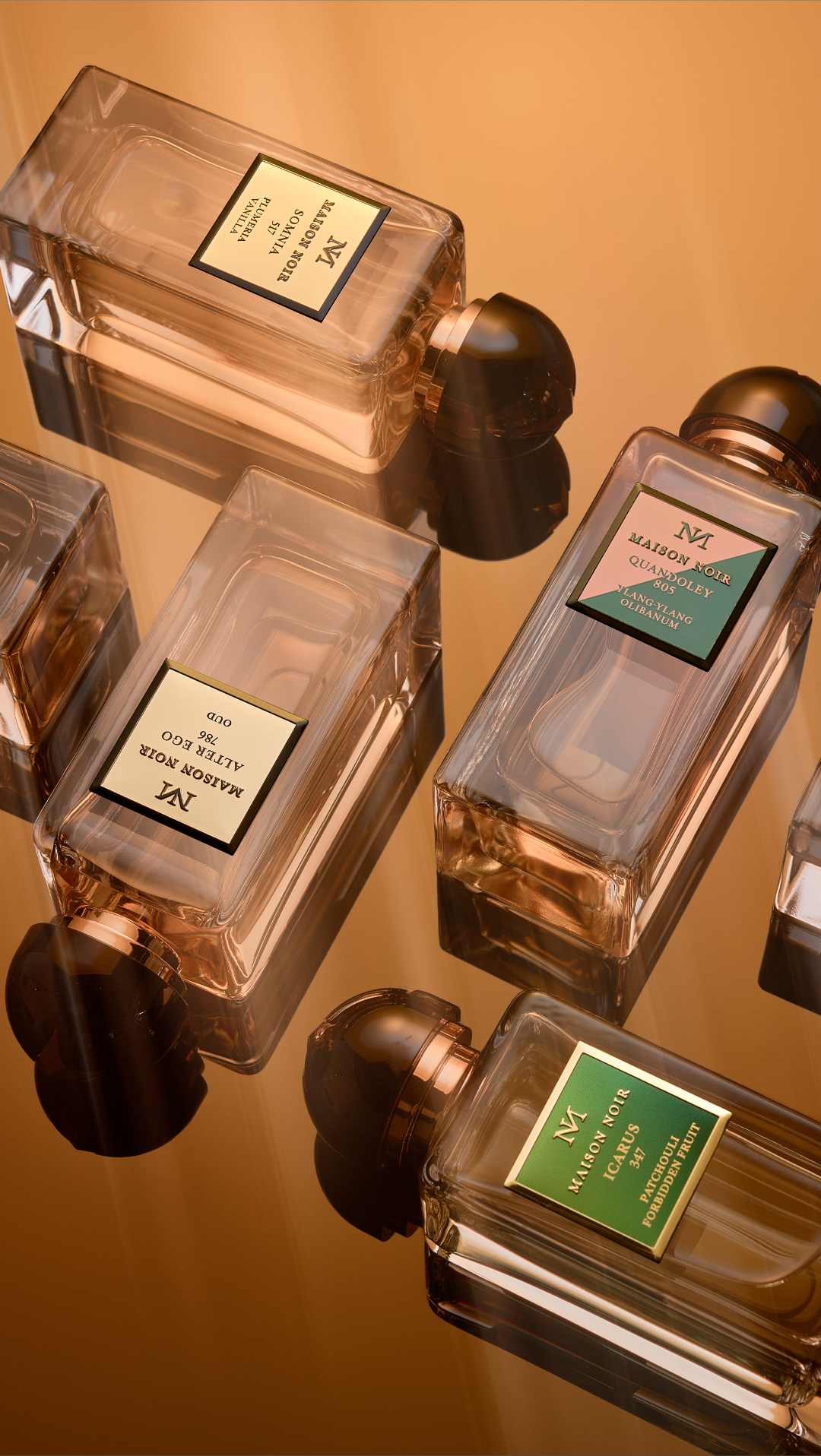
Maison Noir illustrates the niche production model directly. "Born in Switzerland. Crafted in France." points to a workflow where the design sensibility and the perfumery craft each receive dedicated attention, without the overhead of mass-market distribution. The fragrances reach nearly 30 countries through a curated network, which keeps distribution intentional and keeps the formula from being diluted to meet lower price-point targets.
---
Niche Perfume vs. Designer Fragrance: A Side-by-Side View
The structural differences between niche perfume vs designer fragrance become clearer when you line up the key dimensions. Both categories contain excellent and mediocre work, so this table describes tendencies, not guarantees.
| Dimension | Niche Perfume | Designer Fragrance |
|---|---|---|
| Creative brief | Driven by perfumer vision or house concept | Driven by brand marketing and broad consumer appeal |
| Ingredient sourcing | Raw materials and high-grade synthetics, often sourced selectively | Commodity accords and cost-controlled blends are common |
| Typical concentration | EDP or extrait is the standard launch concentration | EdT or lighter concentrations are typical; EDP exists but varies |
| Production scale | Small to medium runs, limited doors | Large-scale global production and wide retail distribution |
| Distribution | Specialty boutiques, house website, curated stockists | Department stores, duty-free, mass-market channels |
| Perfumer credit | Often named and central to the narrative | Frequently uncredited or listed as a footnote |
| Unisex availability | Common across the category; many houses launch as unisex by default | Exists, but the majority of launches are gendered by marketing |
What the table cannot capture is the sensory and emotional texture of the experience. A designer fragrance can be precisely the right choice for a given moment. A niche fragrance can disappoint if the composition does not suit your skin chemistry or your occasion.
---
How the Difference Feels on Skin
The difference between niche and designer fragrance is not purely abstract. You notice it in how a composition develops across the day, how much changes between application and dry-down, and how much the fragrance rewards attention.
Designer fragrances are often engineered for immediate appeal. The opening is designed to land in under thirty seconds, because that is roughly how long a shopper at a counter will evaluate a blotter. There is nothing wrong with this approach. It produces a clean, consistent, broadly wearable result. What it tends not to produce is much complexity in the base.
Niche compositions are typically designed with the full arc in mind. The opening might be denser or stranger than a designer fragrance, because the perfumer is not optimising for a thirty-second audition. What you get instead is a scent that earns its full character over two to three hours of wear.
Alter Ego 786 from Maison Noir illustrates this well. The smoky top note and hints of raspberry resolve into a solid oud wood base that reads quite differently on skin than it does on first spray. That progression is the point. Bohemia 265 moves from fresh bergamot and aromatic cardamom toward a quieter foundation of amber vetiver, and the transition rewards patience. Icarus 347 opens with forbidden fruit and patchouli, then settles into tonka beans and ambroxan, a warm, skin-close finish that reads as presence rather than volume.
This is where the concept of "quiet luxury perfume" is most usefully understood. It describes a quality of restraint and complexity, a fragrance that does not announce itself across a room but reveals itself gradually to those close enough to notice. That quality shows up in niche perfumery far more often than in the designer mainstream, not because niche houses are trying to be understated, but because they are not competing for the loudest shelf impression.
Matching fragrance character to occasion and season becomes more intuitive once you understand how development differs. And how fragrance families shape the wearing experience gives you the vocabulary to identify which families tend to reward longer wear.---

Alter Ego 786
Experience how niche craftsmanship translates to skin with Alter Ego 786.
$125.00 - $195.00
Shop Now →Who Each Category Is Really For
Niche fragrance suits people who want to understand what they are wearing, not just smell pleasant. Designer fragrance suits people who want reliable, broadly legible scent with immediate appeal. Neither answer is a criticism of either category.
If you are transitioning from designer fragrance to niche, the adjustment is less about price than about expectation. You may find that a niche fragrance opens strangely, or takes longer to settle, or reads very differently on your skin than it did on someone else's. That variability is part of the experience, not a quality problem. Approach the first weeks of niche fragrance exploration as a process, not a transaction.
For gifting, the category difference matters practically. Shoppers report actively seeking niche fragrance recommendations as gifts for men or anyone who already owns several designer bottles, precisely because niche offers something a designer collection is unlikely to duplicate. A well-chosen niche fragrance as a gift signals that you understand the recipient's curiosity, not just their taste.
Budget is a real constraint. People report using retailer sample programs and mini sets to explore niche and luxury fragrances before committing to full bottles. This is not a workaround. It is the sensible approach, particularly in the niche category where a full bottle represents a more considered investment.
Discovery sets address the objection of cost directly. You are not buying a bottle blind. You are buying access to a range of compositions, wearing them on skin, and making an informed choice. That is a better use of a limited fragrance budget than a full bottle of something you selected from a blotter at a department store counter.
Finding the fragrance that fits your sensibility takes time, and how to use fragrance samples to explore before committing gives you a practical method for doing it well.---
How to Start Exploring Niche Fragrance Without Committing Blind
The most practical way to start with niche fragrance is a curated sample set. Wear one fragrance per day, let it develop across the full arc of wear, and note what you find at each stage.
A well-curated discovery set helps a new wearer make genuinely informed choices, and here is why: niche fragrances frequently change significantly between application and dry-down. A sample worn for twenty minutes at a counter will not tell you what you actually get. A sample worn for a full day will.
Practical advice for getting the most from a discovery set:
- Wear one fragrance per day, not several at once. Skin chemistry interacts with each composition differently, and layering makes it impossible to evaluate either.
- Apply to clean skin in the morning. Note the opening, check again after two hours, and again in the evening. The base is where the character lives.
- Keep simple notes: what you noticed, what changed, what occasion it suited. You do not need a system; you need enough information to remember which one you want to revisit.
Maison Noir describes each fragrance in its collection as a numbered gateway, a door in an imagined townhouse that opens onto its own world. The house language "smell with your eyes" reflects this: the fragrances are expressed visually and systematically, through their numbers and imagery, so you can orient yourself in the collection before you wear. The Maison Noir Discovery Set is built around this idea. You can explore Maison Noir's numbered collection as samples before buying, which is exactly how the house intends the collection to be entered.
How to evaluate fragrance samples properly covers the method in full, and once you find your starting point, experimenting with fragrance once you have found your starting point opens the next chapter.---

Discovery Set
Explore multiple niche fragrances risk-free with our curated discovery set.
$45.00
Shop Now →Frequently Asked Questions
These are the questions readers most often ask when weighing niche perfume vs designer fragrance. Each answer leads with the direct answer, then adds the context that makes it useful.
What defines a niche fragrance?A niche fragrance is one produced by an independent house whose creative brief is shaped by the perfumer's vision and the house's concept, rather than by mass-market appeal or a fashion brand's commercial calendar. Niche houses typically produce in smaller quantities, distribute through fewer and more curated channels, and credit their perfumers openly. For a fuller breakdown, a deeper explanation of what makes a fragrance house niche is worth reading before you buy.
What separates a true luxury perfume house from a designer fragrance brand?A luxury perfume house, whether niche or not, prioritises raw material quality and creative integrity over marketing scale. A designer fragrance brand uses fragrance as one product among many in a broader lifestyle portfolio, which means formula decisions are often shaped by distribution costs, celebrity campaigns, and the need to appeal to the broadest possible consumer. The two can overlap, but they are not the same structure.
What does quiet luxury perfume mean compared to regular designer fragrances?"Quiet luxury perfume" describes a quality of restraint and complexity: a composition that does not announce itself loudly but reveals depth gradually. It is not a market segment with strict criteria. Many niche fragrances carry this quality by design, because they are not optimised for a thirty-second retail audition. Some designer fragrances achieve it too, but it is less common because mass-market briefs tend to favour immediate and broad impact.
What makes a good first unisex niche fragrance for someone transitioning from designers?Look for a fragrance built around a legible accord that still offers more development than you are used to. Something with a clear opening note that resolves into a more complex base gives you a familiar entry point without feeling flat. Bohemia 265 from Maison Noir, with its bergamot and cardamom top resolving to amber vetiver, is a reasonable starting point for someone comfortable with fresh or aromatic fragrances but wanting more texture beneath.
Is a fragrance discovery set appropriate for someone new to wearing perfume?Yes, and arguably more appropriate than buying a full bottle first. A discovery set lets you wear fragrances on your own skin across a full day, which is the only reliable way to know how a composition develops on you. People report using sample programs and mini sets as their primary tool for exploring niche fragrance before committing, and this is exactly what those sets are designed for.
What would make a good niche fragrance gift for someone with an existing designer collection?Choose a composition that does not duplicate what they already own. If they wear fresh, clean designer fragrances, look at something with more depth in the base: an oud-forward scent like Alter Ego 786, or a vanilla-anchored composition like Somnia 517. A discovery set is also a strong gift choice because it hands the choice to the recipient, which is respectful of a collection they have already curated with care.
What characteristics distinguish a niche fragrance brand from mainstream options?Niche brands typically operate with smaller production runs, name their perfumers, distribute through a curated and limited network, and build formulas around ingredients chosen for the composition rather than the cost model. Mainstream options distribute as widely as possible, rely more heavily on commodity accords, and invest a significant portion of budget in advertising rather than the formula itself.
---
Choosing with Intention
The most useful conclusion from the niche perfume vs designer fragrance comparison is that neither category is inherently superior. They are built for different purposes, and the right choice depends on what you want from the experience.
Designer fragrance offers broad appeal, reliable performance, and easy access. Niche fragrance offers creative depth, ingredient quality, and compositions designed to reward attention rather than capture it quickly. Both have their place in a considered collection.
If you are curious about niche fragrance but have not yet committed to a full bottle, the sensible path is the one the category itself recommends: wear before you buy. You can sample several of Maison Noir's numbered fragrances before choosing one through the Maison Noir Discovery Set, which is how the house invites you to enter its collection. And if you want to start with a clearer sense of what suits your sensibility, a guide to finding the fragrance that suits you is the right place to begin.
Read more
How to Wear Fragrance Mist: When a Lighter Format Is the Right Choice A fragrance mist is a water-based or alcohol-light scent formulation containing roughly one to three percent aromatic compou...
EDP vs Parfum explained: concentration levels, longevity, projection, price, and when to choose each. A practical guide for deliberate fragrance buyers.